Table of Contents
ToggleHome security has evolved dramatically over the past few years, and long range security cameras now sit at the center of most residential surveillance setups. Whether you’re protecting a sprawling property, monitoring a driveway that stretches far from your house, or keeping watch over a wooded perimeter, a long range security camera can see what standard cameras simply can’t reach. In 2026, these systems offer crystal-clear image quality at impressive distances, integrate seamlessly with smart home ecosystems, and deliver night vision that rivals professional-grade equipment. This guide walks you through what makes a long range camera worth the investment, which features actually matter, and how to position them for the coverage your property needs.
Key Takeaways
- Long range security cameras capture clear, usable footage at distances exceeding 100+ feet, providing early warning for trespassers and suspicious activity on sprawling properties.
- Optical zoom (10x to 30x) combined with 4K resolution and larger sensors are essential features that distinguish effective long range cameras from standard surveillance equipment.
- Starlight or ultra-low-light sensors outperform infrared night vision for long range coverage, as IR becomes unreliable beyond 50–60 feet in outdoor environments.
- Proper installation at heights of 10–12 feet with strong power and network infrastructure—preferably PoE connections—ensures your long range camera system performs reliably and captures critical footage.
- Mounting near reflective surfaces like windows or shiny siding can cause IR washout and image degradation, requiring strategic repositioning or shade adjustments for optimal performance.
What Are Long Range Security Cameras and Why They Matter
A long range security camera is designed to capture clear, usable footage at distances that would render standard cameras essentially blind. While a typical dome or bullet camera maxes out at 20–30 feet of clear detail, a long range model can maintain facial recognition or license plate clarity at 100+ feet depending on the lens and sensor.
Why does this matter for homeowners? Property lines aren’t always close to your house. Driveways wind through trees. Perimeter fences sit deep on wooded lots. A long range camera catches trespassers, vehicle movements, and suspicious activity while they’re still a good distance away, giving you reaction time rather than just recording after-the-fact evidence. They’re also indispensable for rural properties where setback distances naturally create gaps in typical camera coverage.
These cameras achieve their reach through a combination of optical zoom (actual glass magnification), larger sensors, higher resolution imaging (typically 4K or higher), and advanced image processing. Homeowners who’ve retrofitted long range models often report catching package theft, animal activity they never knew existed, and unwanted visitors before they ever reach the property perimeter. Unlike traditional security systems that rely on motion detection near your home, long range cameras give you what security professionals call “early warning.” The Lorex Smart Home Security Center offers systems built specifically for this extended coverage scenario, bundling long range cameras with centralized monitoring so you’re never flying blind on remote corners of your property.
Key Features to Look For in a Long Range Camera
Not all long range cameras are created equal, and specs on a box don’t always tell you what you’re actually getting in the field. Here’s what separates a solid performer from an overpriced letdown.
Optical and Digital Zoom Capabilities
Optical zoom is your friend: digital zoom is a polished-turd compromise. Optical zoom uses actual glass elements to magnify the scene without losing sharpness, you’re literally bending light to see farther. Digital zoom crops and enlarges the image, which doesn’t improve detail: it just makes a smaller portion of what the camera already sees look bigger and softer.
A quality long range camera should offer 10x to 30x optical zoom (sometimes labeled as a focal length range, like 4.7mm to 141mm). Cameras with motorized zoom lenses let you adjust magnification remotely, so you can fine-tune your view without climbing a ladder. Check whether the camera’s autofocus system keeps pace with zoom, cheap implementations hunt for focus when you zoom in, making the feed jittery.
Resolution matters here too. A 4K sensor (3840×2160 pixels) paired with a long range lens is the sweet spot for 2026. You’ll grab usable detail at distance without needing 8K resolution, which drains bandwidth and storage faster than most home networks can handle. Entry-level 2MP (1920×1080) cameras are fine for close-range entry monitoring, but they’ll disappoint you at distance.
Night Vision and Low-Light Performance
Daylight range is half the battle: night vision makes or breaks a long range system. Infrared (IR) night vision works by flooding the scene with invisible IR light and capturing the reflection, but IR has a critical flaw: it doesn’t carry far. Beyond 50–60 feet, IR becomes unreliable outdoors. For true long range night coverage, look for cameras with starlight or ultra-low-light sensors, these amp up the camera’s sensitivity to available light (streetlights, moonlight, ambient glow) rather than relying on IR.
Some newer models blend approaches: they use IR for shorter distances and switch to ambient-light sensing for far-field coverage. Recent advances, like those in Eufy’s E40 camera with its LongRange Module, demonstrate how AI-assisted night vision can isolate subjects even in nearly-dark conditions.
When shopping, ask whether the camera uses a rolling shutter or global shutter. Global shutter is faster and handles motion better (fewer artifacts when cars drive past), though it’s pricier. Read real-world reviews, spec sheets won’t tell you if night vision is actually usable at your property’s distance, so search for footage recorded at ranges similar to yours.
Installation Tips for Maximum Coverage
Even the best long range camera delivers nothing if it’s mounted in the wrong spot. Here’s how to position and install for serious coverage.
Height and Angle
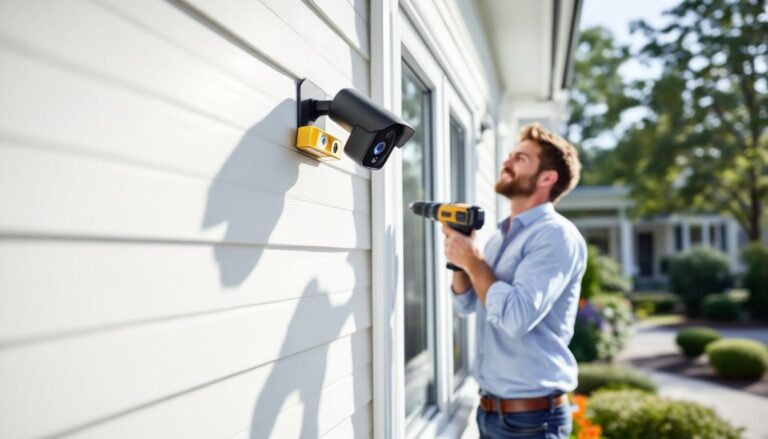
Mount the camera as high as practical, roof eaves, second-story soffit, or a 10–12-foot pole in open areas. Height reduces obstructions (trees, shrubs) and extends your effective range. Aim for a sight line that covers your driveway, property perimeter, or vulnerable areas. Unlike security cameras focused on doorways, long range models benefit from being tilted slightly downward to catch faces and vehicle details rather than just overhead views.
Power and Network
Long range cameras, especially models with motorized zoom and advanced sensors, draw more power than basic models. Plan for PoE (Power over Ethernet) if possible, a single cable delivers both power and data. If that’s not feasible, run a weatherproof outdoor-rated electrical line with a dedicated circuit. Avoid extension cords: they’re a fire hazard outdoors and degrade power delivery. For network connectivity, position your WiFi router, mesh node, or hardwired network access point so the camera has strong signal. A weak connection causes lag, dropped frames, and failed uploads during critical moments.
Weather Sealing and Protection
Buy a camera rated IP67 or better (IP ratings define dust and water resistance). This matters even under eaves, wind-driven rain and humidity will find gaps. Ensure all connector ports are sealed and caulked once installed. Check that the camera’s IR filter (if it has one) isn’t fogged by condensation: a tiny vent with a hydrophobic membrane lets moisture escape while keeping water out.
Avoiding Glare and Reflection
If you’re mounting near windows, glass surfaces, or shiny siding, the camera’s own IR light (if equipped) will bounce back and wash out the image at night. Reposition slightly, add a small sunshade, or, if you’re using starlight night vision, orient the camera so side-lighting doesn’t create hotspots. CNET’s product reviews and guides often feature real-world installation photos that highlight these pitfalls.
Wiring and Cable Management
Run cables in conduit if exposed to sunlight or foot traffic. UV degrades unprotected cable jackets within 2–3 years. If you’re fishing cable through walls or soffits, mark the path clearly so future work doesn’t nick the line. Keep cables at least 12 inches away from electrical wiring to minimize EMI (electromagnetic interference), though modern cameras are usually shielded well enough that this is less critical than it was in older systems.
Testing Before Final Install
Before permanently mounting, position the camera where you think it belongs, power it up, and walk the property to verify coverage. Check night vision quality, zoom accuracy, and whether motion detection triggers appropriately. Digital Trends coverage of smart home tech includes setup guides that walk through these field tests in detail. Adjust zoom, angle, and sensitivity settings during this dry run, it’s far easier than climbing back up after install.
Conclusion
Long range security cameras bridge the gap between standard surveillance and professional-grade installations. By prioritizing optical zoom, sensor quality, and honest night vision performance, you’ll deploy a system that actually catches detail at distance rather than just recording silhouettes. Thoughtful placement, solid power and network infrastructure, and weather-resistant installation ensure your investment pays off for years. Your property’s specific layout will dictate which focal length and zoom range works best, but the fundamentals, quality optics, 4K resolution, and starlight-capable night vision, remain constant across different manufacturers and price points.