Table of Contents
ToggleIf your home doesn’t have reliable internet, or you just don’t want to add another connected device to your network, a battery-powered security camera without WiFi might be exactly what you need. These systems operate independently, recording footage locally to an SD card, hard drive, or built-in storage instead of uploading to the cloud. They’re straightforward to install, require no subscription fees, and keep your surveillance data entirely under your control, a genuine advantage for privacy-conscious homeowners. Whether you’re protecting a detached garage, cabin, rental property, or just prefer offline security, understanding how these cameras work and how to set them up properly makes all the difference in getting reliable protection.
Key Takeaways
- Battery-powered security cameras without WiFi record footage locally to SD cards or hard drives, eliminating monthly cloud subscription fees and protecting your surveillance data from internet vulnerabilities.
- Mount outdoor cameras 8–12 feet high on eaves or poles angled to capture faces and vehicle details, avoiding backlighting from windows to ensure clear, usable footage.
- A battery-powered offline camera requires smart motion detection settings, regular lens cleaning, and monthly voltage checks to maintain reliable performance and extend battery longevity.
- SD card systems work best for single-camera setups protecting sheds or gates, while hard drive or NAS solutions suit multi-camera properties needing centralized, searchable offline storage.
- Test camera placement at dawn, dusk, and night before finalizing installation, and use stainless steel hardware with silicone sealant to ensure secure, weatherproof mounting in outdoor conditions.
- Battery life of 3–6 months per charge is practical for normal use; models with solar panel support provide indefinite runtime, making them ideal for remote locations with no power outlets.
Understanding Battery-Powered Cameras With Local Storage
A battery-powered security camera without WiFi is a self-contained recording device. Instead of streaming live footage to your phone or cloud storage, it captures video directly to local media, typically an SD card or small hard drive, and operates on rechargeable or replaceable batteries. Some models include a base station or hub that sits nearby (within radio range), which acts as the local “brain” and manages recording, playback, and motion detection.
The trade-off is straightforward: you won’t get real-time alerts on your phone, and you’ll need to physically retrieve the storage card or access the device to review footage. But this isolation also means no monthly cloud subscription, no WiFi hacking risk, and no reliance on internet uptime. For homeowners who value privacy or operate in areas with poor connectivity, these systems make genuine sense. They’re also ideal for capturing evidence in locations where power outlets and internet aren’t available, sheds, gates, rental cabins, or temporary monitoring during renovations.
Key Features To Look For When Choosing a No-WiFi Camera
When shopping for a battery-powered offline camera, focus on these practical specs:
Battery life and power options. Look for models rated for at least 3–6 months per charge under normal use, or consider rechargeable batteries versus non-replaceable packs. Some units support solar panels for trickle charging, which extends runtime indefinitely, a smart move for remote locations.
Storage capacity and media type. Cameras typically use microSD cards (up to 512 GB) for compact setups, or larger SD cards and external drives for continuous or longer-term recording. Check the frame rate (fps) and resolution, 1080p at 30 fps is the practical minimum: 4K offers more detail but chews through storage faster.
Motion detection sensitivity. Battery cameras need smart motion triggers to avoid draining power recording empty scenes. Adjustable sensitivity, masking (ignoring certain zones), and daylight/nighttime scheduling are essential. Recent offerings feature product reviews from trusted tech outlets like CNET that compare detection accuracy across models.
Night vision. Infrared (IR) LEDs provide black-and-white footage in darkness without WiFi connectivity. Check the IR range, 15–25 meters is typical for affordable models. Some premium units add thermal or color night vision.
Weather resistance. Any outdoor camera needs IP65 or better (dust-proof, water-resistant under pressure spray). Confirm the temperature rating if you’re installing in extreme climates.
How Local Storage and Offline Recording Work
Local storage means the camera writes video directly to its SD card or connected drive as motion is detected or on a schedule. Here’s the workflow:
Recording modes typically include continuous loop (overwrites oldest footage), event-only (records on motion trigger), or scheduled (records during set hours). Loop recording prevents storage overflow but means older footage disappears. Event-based saves space but requires properly tuned motion sensitivity to catch important moments.
Playback happens on the device itself, via a small LCD screen, or by removing the storage card and loading files on a computer. Some battery cameras include a USB or HDMI port for direct connection to a TV or laptop. Ensure the camera exports footage in standard formats (MP4, AVI) so you’re not locked into proprietary software.
Retention time depends entirely on storage size and bitrate. A 64 GB SD card recording continuous 1080p video holds roughly 8–12 hours of footage. Event-based recording extends this significantly, perhaps weeks of clips if motion is sparse. Know your needs: are you catching daily activity, or looking for occasional incidents?
Installation Tips for Maximum Coverage and Performance
Proper placement matters far more than the camera itself. Before mounting, walk the area at dawn, dusk, and night to understand lighting and sightlines.
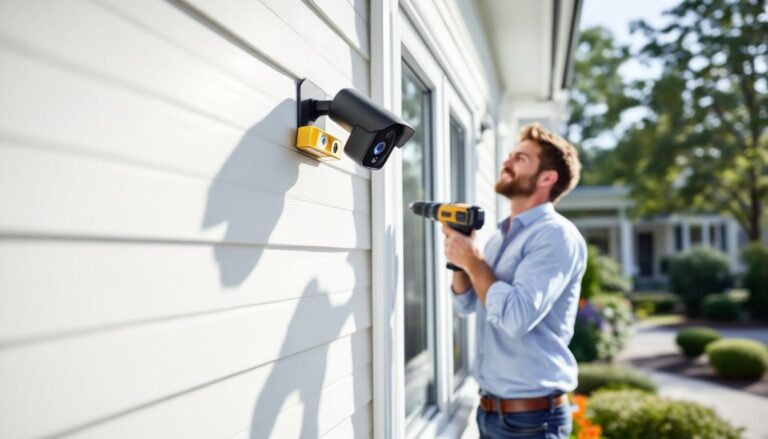
Height and angle. Mount outdoor cameras 8–12 feet high on an eave, fence post, or pole, high enough to avoid tampering but angled to capture faces and vehicle details, not just the top of heads or license plates. Indoor cameras work best at 4–6 feet, positioned to monitor entry points and high-value zones.
Avoid backlighting. Don’t point directly at bright windows or lights: they create blown-out, useless footage. A slight angle (15–30°) usually solves this. Test the view by reviewing a sample recording before finalizing placement.
Weatherproofing and power. If the camera isn’t fully weatherproof, add a small roof or baffle above it. For battery models, ensure monthly or seasonal access for charging or battery swap, don’t mount it so high you need a ladder every six weeks. Solar panels, if applicable, should face south (in the Northern Hemisphere) and avoid shade.
Secure mounting. Use stainless steel hardware and matching tamper-proof screws or mounting brackets. Aluminum or plastic can corrode: avoid it. Apply a thin bead of silicone sealant around the base to keep water out of cable holes.
Maintenance and Battery Longevity Best Practices
Battery-powered cameras are low-maintenance, but neglect kills performance. Here’s what matters:
Battery health checks. Mark your calendar for monthly voltage checks using a multimeter, especially in cold months when alkaline performance drops. Rechargeable batteries (Li-ion, NiMH) lose capacity over time: expect 50–70% capacity after 2–3 years of heavy use. Replace rather than refresh when runtime falls below 2–3 months.
Lens and sensor cleaning. Dust, spider webs, and salt spray degrade image quality fast. Clean the lens monthly with a dry microfiber cloth and isopropyl alcohol on a cotton swab. Check the infrared lens (the dark dome around the LEDs) too, it gets just as dirty.
Storage card maintenance. Reformat SD cards in the camera, not your computer, to avoid file corruption. Every 6–12 months, replace the card if it’s showing signs of wear (repeated write errors, file corruption). Cheap cards save $10 but fail unpredictably: invest in Class 10 or UHS-II rated cards for reliability.
Firmware and settings. Some battery cameras accept occasional firmware updates. Check the manufacturer’s website quarterly. Ensure motion sensitivity is properly calibrated, too high wastes power, too low misses events. Disable unnecessary features (audio recording, streaming) to save battery.
Comparing Offline Options: SD Cards vs. Hard Drives vs. Cloud-Free Systems
Three main local storage approaches exist: each suits different scenarios:
SD card systems are the most common for battery cameras. Compact, affordable, and easy to swap. Typical capacity runs 64–512 GB, storing weeks to months of event-based footage. Downsides: cards are easy to lose, have limited write cycles (eventually fail), and require manual extraction and playback. Best for homeowners needing occasional evidence.
Hard drive systems (external USB or NAS) handle larger volumes, 1–8 TB, supporting multiple cameras or continuous recording. They’re stationary, sitting near a hub or base station, and require AC power. Downside: overkill for simple battery camera setups and adds cost. Useful if you’re combining multiple cameras into a unified offline system.
Hybrid systems include smart home technology guides from Digital Trends that discuss camera options with built-in eMMC storage (non-removable internal flash, typically 64–128 GB). No card to lose, but slower transfers and less flexibility than removable storage. Growing in popularity for mid-range units.
For a single battery camera protecting a shed or gate, an SD card is practical and economical. For a full property with multiple cameras, a local NAS or external hard drive plus a base station gives you centralized, searchable footage without monthly fees. Avoid assuming you need “cloud-free” marketing: confirm the camera actually stores locally and doesn’t require an internet connection to function.
Conclusion
Battery-powered security cameras without WiFi deliver straightforward, private surveillance for homes where connectivity is poor or unwanted. They’re honest tools: no cloud fees, no subscription traps, no constant device syncing. Installation is approachable, mount high, angle for faces, secure with stainless hardware, and ongoing maintenance amounts to occasional battery swaps and lens cleaning. Understand your storage needs (SD card versus hard drive), test placement before committing, and choose models with honest specs on battery life and motion detection. For homeowners valuing control and self-reliance, these systems earn their place alongside traditional network cameras.